
Best Pet Insurance in Texas in 2026: 9 Providers Ranked by Value
Compare Texas pet insurance costs and any-vet coverage for dogs and cats before the next emergency
Your Texas pet insurance is only as good as the nearest vet who takes it. That test turns out to be easy to pass: all nine carriers on this list pay at any licensed veterinarian in the state, so choosing the best pet insurance in Texas comes down to what you’ll pay each month and what the fine print takes away.
The fine print matters more here than in most states. Texas spreads its pet owners across 254 counties, and emergency animal hospitals cluster in the big metros. An after-hours crisis in ranch country can mean an hour on the highway before anyone reads an X-ray, and the clinic you reach will charge a $75 to $120 exam fee that many policies refuse to reimburse.
The money at stake is real. MarketWatch pegs the average Texas premium at $44 a month for dogs and $25 for cats, built from quotes at 18 carriers across 10 sample pets. A routine visit for an uninsured dog runs $67 at Banfield’s Texas clinics, and a dental cleaning adds $395.
The nine providers below earned their labels through published Texas rate data and each carrier’s own policy terms, checked against tens of thousands of Trustpilot reviews. The methodology at the bottom explains the sorting, and the cost section breaks down what Texans pay city by city.
Best pet insurance in Texas
- Best overall value in Texas: Lemonade
- Best for customizable plans: ASPCA Pet Health Insurance
- Best for budget premiums: Figo
- Best for cheap cat coverage: Pets Best
- Best for older pets: Spot
- Best for big vet bills: Pumpkin
- Best for dental illness: Embrace
- Best for multi-pet households: MetLife Pet
- Best for paying the vet at checkout: Trupanion
Best overall value in Texas: Lemonade

Who’s this for? Texans who can’t count on the nearest emergency clinic sitting in the same county. Lemonade operates no vet network at all, so a policy bought in Dallas pays the same at a border-town clinic in Laredo or an overnight ER in Lubbock. Add its vet visit fee option and the exam charge itself, an expense most base policies skip, comes back with the rest of the claim.
Standout feature: The visit fee add-on reimburses the $75 to $120 a Texas clinic collects before treatment starts. Across a couple of sick visits a year, that add-on can return more than it costs.
Lemonade
Cost
Around $35 to $40 a month for a typical Texas dog, less for cats. Each added pet shaves up to 10%, annual payment up to 5%, and bundling a Lemonade home or renters policy trims up to 10% more.
Standout features
Claims filed by video in the app, with simple ones paid in minutes. Add-ons cover physical therapy and the vet visit fee.
Reimbursement choices
70% to 90% reimbursement across a range of annual limits.
Waiting periods
Accidents carry no wait, illnesses take 14 days, and orthopedic conditions take 30.
Vet access
Any veterinarian licensed in the US. No network, no pre-approval to see a specialist.
Wellness options
Routine Vet Care packages handle annual exams and vaccines; the Plus tier adds spay or neuter surgery and microchipping.
Pros
- Trustpilot readers hand it 4.1 out of 5 from 6,089 ratings, and fast claim payouts draw the most praise
- Exam fee add-on plugs a gap most Texas policies leave open
- Works at every licensed vet in the state
- Discounts stack across annual payment, extra pets, and bundles
Cons
- The base plan runs lean; dental illness, physical therapy, and the vet visit fee all cost extra as add-ons
- Trustpilot complaints describe waiting periods that surprised buyers after signup
- Coverage hasn’t reached every state yet
Best for customizable plans: ASPCA Pet Health Insurance

Who’s this for? Owners who want to turn the dials themselves. ASPCA Pet Health Insurance pairs deductibles and annual limits into whatever premium fits your budget, and its Complete Coverage plan folds in hereditary and behavioral conditions that several rivals treat as extras. A 30-day money-back window softens the commitment.
Standout feature: Behavioral coverage. Anxiety ranks among the most common Texas pet diagnoses, and ASPCA treats it as a covered illness rather than an upsell.
ASPCA Pet Health Insurance
Cost
Quote-based; state roundups place Texas dog plans in the $40s per month. Multi-pet households get 10% off.
Standout features
Complete Coverage plans reach 90% reimbursement and fold in behavioral therapy.
Reimbursement choices
Up to 90%, with multiple deductible and limit combinations.
Waiting periods
A flat 14 days for both accidents and illnesses, and no separate orthopedic clock.
Vet access
Any licensed veterinarian across the US or Canada.
Wellness options
Optional preventive add-ons for routine exams and vaccinations.
Pros
- The standard plan builds in hereditary, congenital, and behavioral conditions
- Full refund inside the first 30 days if you haven’t filed a claim
- Editorial reviewers name it best overall more than any other carrier
Cons
- Premiums climb as pets age, a recurring Trustpilot complaint
- Reviewers report reimbursement delays, and the 3.7/5 Trustpilot score trails most rivals here
- No published rates, so you’ll need a quote to see real numbers
Best for budget premiums: Figo

Who’s this for? Price-first shoppers who live in apps anyway. MarketWatch prices Figo about 36% below the $34 statewide monthly average, the cheapest carrier in its Texas sample, and the Pet Cloud app handles everything from policy documents to claim uploads.
Standout feature: A 100% reimbursement tier, rare in this market, which erases coinsurance on covered claims once the deductible clears.
Figo
Cost
Quote-based; the cheapest Texas carrier in MarketWatch’s 18-provider sample, close to a third below the statewide average.
Standout features
Pet Cloud app with round-the-clock virtual vet chat on every plan.
Reimbursement choices
70% up to a rare 100% option, with unlimited annual limits available.
Waiting periods
Figo advertises short accident and illness windows; check the Texas policy form for exact days.
Vet access
Any licensed vet.
Wellness options
Extra-care add-ons for routine visits.
Pros
- Lowest quoted premiums in Texas per MarketWatch
- 100% reimbursement option
- 24/7 virtual vet access at no extra charge
Cons
- 3.4/5 on Trustpilot, the lowest score in this group
- Reviewers describe claim denials and slow processing
- Reviewers also flag billing problems
Best for cheap cat coverage: Pets Best

Who’s this for? Cat owners watching every dollar. Pets Best writes Texas cat plans from $14.80 a month, about $177 a year, and its accident-only tier starts at $6 for cats and $9 for dogs. Twenty years in this business and 900,000-plus insured pets stand behind the pricing.
Standout feature: A 2-day accident waiting period, one of the shortest in the category, so injury coverage starts before the first week ends.
Pets Best
Cost
Dog accident-and-illness plans list between $36 and $58 per month, with cats at $22 to $34. Texas cat coverage from $14.80.
Standout features
Optional direct payment to the vet at participating clinics, which skips the reimbursement wait on big bills.
Reimbursement choices
As high as 90%, and the top BestBenefit tiers carry no payout cap.
Waiting periods
2 days for accidents, with a 6-month clock on cruciate injuries.
Vet access
Works with any US or Canadian licensed vet.
Wellness options
Optional routine-care add-ons.
Pros
- Cheapest documented cat rates in this group
- Direct vet pay option at participating clinics
- Tiers scale down to a $6-a-month accident-only cat plan
Cons
- Sharp rate hikes year after year lead its Trustpilot complaint log (3.6 out of 5 from 6,246 reviews)
- Some reviewers report slow reimbursements
- Service quality varies from one reviewer account to the next
Best for older pets: Spot
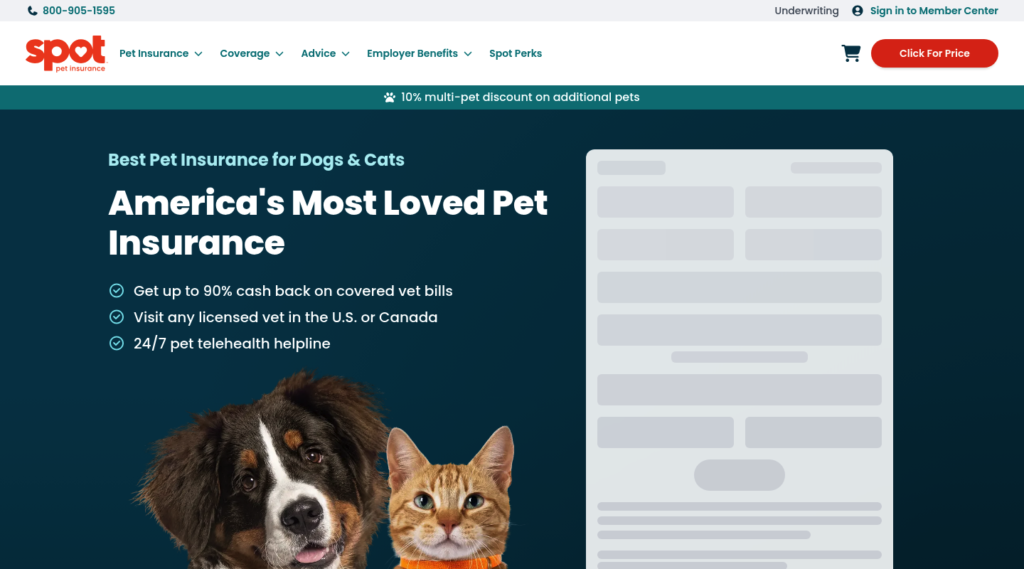
Who’s this for? Owners of senior dogs and cats who keep hitting enrollment age walls elsewhere. Spot takes pets at any age and pairs every plan with a 24/7 telehealth line. Its 4.7/5 Trustpilot score across 11,430 reviews stands among the strongest in the category.
Standout feature: No upper age limit to enroll. A 12-year-old Lab qualifies for the same accident-and-illness plan as a puppy.
Spot
Cost
Quote-based and value-priced, with deductible and annual-limit combinations that reach unlimited coverage.
Standout features
24/7 telehealth helpline on every plan, plus behavioral and microchip coverage.
Reimbursement choices
Up to 90% cash back, with annual caps that scale all the way to unlimited.
Waiting periods
Both accidents and illnesses carry a 14-day wait, and there’s no extra orthopedic clock.
Vet access
Any vet holding a US or Canadian license.
Wellness options
Preventive-care add-ons at extra cost.
Pros
- Trustpilot shows a 4.7 rating built on 11,430 reviews, and 85% award five stars
- Reimbursements often land within about 48 hours
- No enrollment age cutoff
Cons
- Renewal premiums can climb year over year
- Wellness coverage is an add-on purchase, not part of the base plan
- Some reviewers find the coverage limits and exclusions hard to parse
Best for big vet bills: Pumpkin

Who’s this for? Owners bracing for five-figure treatment plans. Pumpkin pays 90% on every plan and offers an unlimited annual option. Its PumpkinNow service advances cash on an eligible claim before the vet’s invoice comes due, which changes the math on a major surgery.
Standout feature: PumpkinNow, a 24/7 urgent-pay service. On a serious emergency, the insurer’s share can arrive before the hospital’s invoice does.
Pumpkin
Cost
Quote-based, mid-tier to premium. Pumpkin sells preventive packs as a separate non-insurance product.
Standout features
Flat 90% reimbursement with no breed restrictions and no upper age limit.
Reimbursement choices
90% on all plans; annual limits scale up to unlimited.
Waiting periods
Standard category windows; Pumpkin lists exact days during quoting.
Vet access
Any licensed vet.
Wellness options
Preventive Essentials packs, a separate non-insurance add-on.
Pros
- Highest Trustpilot score in this group: 4.8/5, with 90% of reviews at five stars
- Hereditary conditions and dental illness covered in the base plan
- Upfront claim funding through PumpkinNow
Cons
- Premiums run higher than budget rivals
- Preventive care sits outside the insurance policy itself
- A few states can’t buy it at all
Best for dental illness: Embrace

Who’s this for? Owners of breeds prone to bad teeth, or anyone who wants a policy that rewards uneventful years. Embrace will pay up to $1,000 in a policy year toward dental illness, no dental exam needed, and its Healthy Pet Deductible knocks $50 off after each claim-free year.
Standout feature: The shrinking deductible. Skip claims for five years and a $500 deductible becomes $250 in the year you need it.
Embrace
Cost
Quote-based, mid-market. Embrace reports paying 90% of claims within 10 days.
Standout features
Diminishing deductible plus free 24/7 telehealth.
Reimbursement choices
Up to 90% across several deductible and limit pairings.
Waiting periods
1 day for accidents and 14 for illnesses; a vet exam can waive the 6-month orthopedic wait.
Vet access
Any licensed vet, no network.
Wellness options
Wellness Rewards, a flexible routine-care budget.
Pros
- $1,000 in dental illness benefits each policy year
- Deductible shrinks with each claim-free year
- Orthopedic wait shortens after a vet exam
Cons
- Premiums rise with pet age and at renewal
- Trustpilot reviewers (3.9 out of 5 from 10,830 reviews) cite claim denials and limit disputes
- Service consistency draws mixed reports
Best for multi-pet households: MetLife Pet

Who’s this for? Homes where two or three animals share the couch. MetLife Pet’s family plan puts multiple pets under a single deductible, so one dog’s rough year helps clear the threshold for the whole household. Published rates open at $16 for dogs and $7 for cats each month.
Standout feature: No accident waiting period. Injury coverage can begin the day the policy starts, the one 0-day accident clock in this group.
MetLife Pet
Cost
Published starting tiers list dogs around $16 and cats near $7 per month; full pricing requires a quote.
Standout features
Family plan with one shared deductible across pets.
Reimbursement choices
Up to 90% with customizable limits.
Waiting periods
0 days for accidents, the shortest in the category.
Vet access
Any licensed vet.
Wellness options
Optional preventive and dental add-ons.
Pros
- 4.7/5 Trustpilot rating across 10,579 reviews
- One deductible can serve an entire multi-pet household
- Backing from a major national carrier
Cons
- Plan choices get complex fast, a documented buyer complaint
- Renewal increases show up in reviews
- Some reviewers report claim-processing delays
Best for paying the vet at checkout: Trupanion
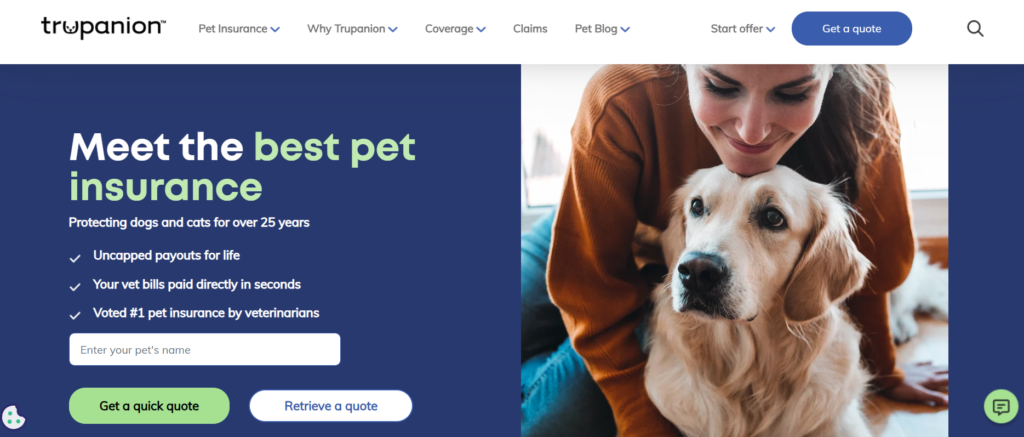
Who’s this for? Owners who never want to front a five-figure invoice. Trupanion’s VetDirect Pay settles with participating hospitals at checkout, and its single plan carries unlimited lifetime payouts and never imposes an annual cap. Veterinarians rate the company well after 25 years and more than $4 billion in claims paid.
Standout feature: The per-condition deductible. You pay it a single time per condition across the pet’s whole life, so a chronic illness stops generating a fresh deductible every January.
Trupanion
Cost
Quote-based and among the priciest in the category; the trade is a plan with no payout ceiling.
Standout features
VetDirect Pay settles bills at participating clinics before you leave the building.
Reimbursement choices
A flat 90% on the single plan, with unlimited lifetime payouts.
Waiting periods
Standard category windows; Trupanion publishes specifics during quoting.
Vet access
Any licensed vet; direct pay works at participating hospitals.
Wellness options
None. Trupanion sells no routine-care coverage.
Pros
- Unlimited lifetime payouts on every policy
- Direct payment removes the reimbursement wait
- 4.4/5 Trustpilot score across 11,771 reviews, with big-claim payouts a recurring praise theme
Cons
- Its premiums land at the market’s high end
- No wellness or routine-care option at any price
- Some buyers find the per-condition deductible model puzzling
What pet insurance costs in Texas
Texas premiums undercut the national picture. MarketWatch’s survey of 18 carriers quoted across 10 sample pets puts the statewide average at $34 a month overall, against a nationwide figure near $46. The dog and cat split, and the spread between sources, looks like this:
| Texas cost benchmark | Dogs | Cats |
|---|---|---|
| Average monthly premium (MarketWatch) | $44 | $25 |
| Average monthly premium (Insurify) | $43 | $23 |
| Average annual spend (Insurify) | $456 | $240 |
| WSJ sample quote ($5,000 limit, $250 deductible, 80%) | $41 | $21 |
| Cheapest documented plan in this group | ~$22 (Figo) | $14.80 (Pets Best) |
Location moves the vet bill underneath those premiums. Pawlicy’s city data shows what a standard visit costs across the state:
| Texas city | Routine dog visit | Routine cat visit |
|---|---|---|
| Austin | $62 | $48 |
| El Paso | $65 | $51 |
| Houston | $68 | $53 |
One convention to know before you pull quotes: the industry quotes from one shared profile: coverage capped at $5,000 a year, a $500 deductible, 80% reimbursement, quoted for a 2-year-old medium mixed-breed. Set every quote to those numbers and the carriers become comparable on sight.
Rural distance and emergency access across Texas
Distance shapes pet care here in a way premium tables never show. Specialty and 24-hour hospitals concentrate in Houston, Dallas-Fort Worth, Austin, and San Antonio; a late-night emergency in the Panhandle or the Big Bend region can start with a long drive to a clinic your pet has never visited. Texas hazards raise the odds you’ll make that drive: extreme heat, venomous snakes, and fire ants all generate claims, and snakebite antivenin alone can push a bill into four figures.
No-network coverage is what makes that drive survivable on paper. Each carrier above reimburses any licensed Texas vet, so an unfamiliar ER counts the same as your regular clinic. The gaps show up elsewhere. Many base policies exclude the $75 to $120 exam fee the receiving clinic charges first, which is where Lemonade’s visit fee add-on separates itself from the pack. Direct-pay arrangements from Trupanion and Pets Best help too, since an unfamiliar hospital would rather bill an insurer at checkout than chase a stranger’s reimbursement. The same logic covers evacuations: a policy that works anywhere in the state keeps working when a Gulf storm sends you inland with a carrier crate in the back seat.
Does pet insurance pay off in Texas
Run the math on a single bad week. A urinary blockage that hospitalizes a cat runs about $2,100. On the standard $500 deductible with 80% reimbursement, the insurer returns $1,280 and you pay $820. Set that against the $25 average monthly Texas cat premium, $300 a year, and one hospitalization returns more than four years of premiums. Emergency visits nationwide run from $1,000 to $3,000 per US News, so a dog owner paying $528 a year at the state average faces similar break-even odds from a single incident.
Texans who own policies seem to agree the trade works: 77% of Texas respondents in MarketWatch’s 2025 survey of 1,000 pet owners reported satisfaction with their insurer. The honest caveat is that a healthy pet in a cheap year makes insurance look like wasted money. Wellness add-ons soften that by paying out on routine care, and the $395 Banfield charges for a Texas dental cleaning shows how fast “routine” adds up.
What to look for in a Texas pet insurance plan
Match the deductible to your emergency fund, since you’ll front every vet bill under the reimbursement model most of these carriers use. A $1,000 cushion supports a high deductible and a lower premium; thin savings argue for the reverse.
Check the exam fee line before anything else in the exclusions. Texas clinics collect $75 to $120 at the door, and a policy that skips it shrinks every claim you file.
Read the waiting periods as a spread. Lemonade and MetLife Pet both start accident coverage the moment the policy activates, while cruciate waits at Pets Best and others stretch to 6 months. Orthopedic injuries are among the most common serious dog claims, so that spread has teeth.
Know what the state does and doesn’t do for you. The Texas Department of Insurance holds carriers to solvency standards and rate filings, but it doesn’t standardize contract language. Search any policy PDF for “bilateral” and “pre-existing” before you buy; those two terms hide the exclusions that surprise people at claim time.
How to compare Texas pet insurance quotes
- Set every quote to the same numbers. Use the industry basis of $5,000 annual coverage, a $500 deductible, and 80% reimbursement so the premiums compare clean.
- Price the add-ons you’d use. An exam fee rider or wellness package changes the value ranking for frequent-visit households.
- Watch the waiting-period clock. Enroll before problems appear; anything a vet notes first becomes a pre-existing condition no carrier will cover.
- Recheck the premium at renewal. Price creep after year one is the most common complaint theme across the Trustpilot records of these nine carriers.
Which pet insurance delivers the best value in Texas
Value in this state means a policy that performs at whichever clinic you can reach, at a price that doesn’t punish you for using it. In 2026, Lemonade passes that test: no vet network anywhere in Texas, an add-on that brings the exam fee itself into the claim, and discounts that pull a $35 to $40 dog premium under the state average. Other profiles point elsewhere. Trupanion suits owners who want the hospital paid at checkout, and Pets Best owns the cheap-cat lane at $14.80 a month. With vet prices in Houston and Austin still climbing faster than premiums, the smart move is locking in coverage while your pet’s record is clean, then holding the policy through the years when it earns its keep.
How this ranking came together
Every figure above comes from published sources: MarketWatch’s 18-carrier Texas premium sample, Insurify and WSJ cost data, Pawlicy’s city-level vet pricing, and each carrier’s posted policy terms. Trustpilot served as the sole review source, more than 69,000 combined reviews across the nine carriers, and every downside listed traces to documented complaints there rather than editorial guesswork. Value carried the heaviest weight in the sorting: Texas-relevant coverage per premium dollar, with review scores as the tiebreaker. Nationwide Pet, a large legacy carrier, sat out this list because it lacks a pet-specific Trustpilot record to compare on equal footing.
Based on those criteria, the picks for best pet insurance in Texas are:
- Best overall value in Texas: Lemonade
- Best for customizable plans: ASPCA Pet Health Insurance
- Best for budget premiums: Figo
- Best for cheap cat coverage: Pets Best
- Best for older pets: Spot
- Best for big vet bills: Pumpkin
- Best for dental illness: Embrace
- Best for multi-pet households: MetLife Pet
- Best for paying the vet at checkout: Trupanion


